Haaretz Today •
Hillary Clinton Blames TikTok for Gaza 'Propaganda.' She Can't See Her Own Complicity
By boiling down backlash against Israel to a social media problem, Clinton and her allies seem to have forgotten they're still in an echo chamber that they built with their own hands and words
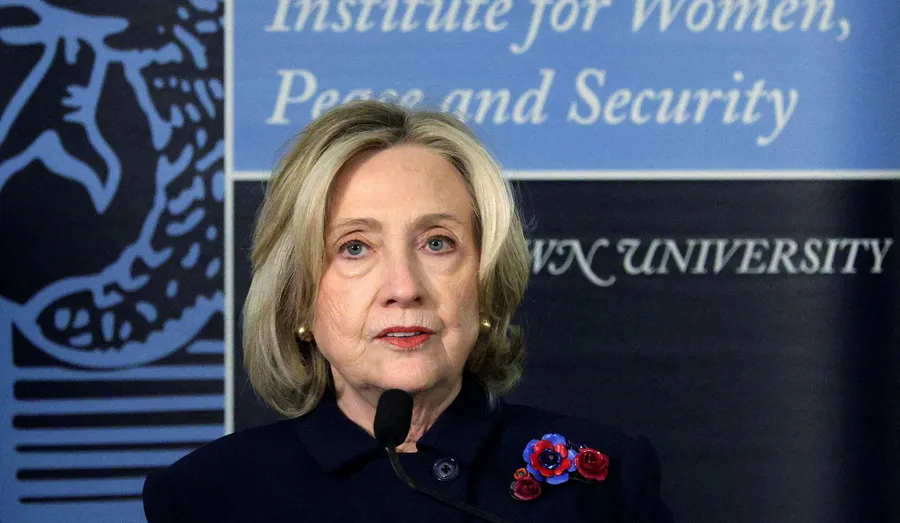
Former U.S. Secretary of State Hillary Clinton delivers keynote remarks during a discussion at Georgetown University Washington, DC, Tuesday. Credit: Getty Images via AFP/Alex Wong

December 03 2025 IST
Former Secretary of State Hillary Clinton sounded the alarm on Tuesday over what she thinks is behind a dramatic negative shift in U.S. public opinion about Israel.
She told a crowd at the Israel Hayom Summit in New York – a newspaper funded by Israeli-American billionaire and Trump megadonor Miriam Adelson – that the problem isn't the occupation, annexation or 70,000 dead Palestinians, but rather young people "getting their information from social media, particularly TikTok."
"When you're trying to engage in reasonable discussion [with young people], it was very difficult because … they had very little context, and what they were being told on social media was not just one-sided, it was pure propaganda," she told the crowd.
Clinton wasn't the only senior Democratic figure in recent weeks blaming social media for Israel losing ground with Americans. Former Obama speechwriter Sarah Hurwitz told a Jewish fundraising event that, in trying to make arguments in favor of Israel, "If all day long your brain is smashed by TikTok with really upsetting carnage in Gaza" then "I am talking through a wall of dead children."
Former Obama advisor Van Jones claimed crudely that Iran and Qatar are running a disinformation campaign through TikTok, joking that "If you are a young person who's opening up your phone, all you see is dead Gaza baby, dead Gaza baby, [P.] Diddy … dead Gaza baby!"
There's a bitter irony in those who worked for Obama, the first President to harness the power of social media for political influence, positing that there is a coordinated online campaign designed to destroy Israel that can only be stopped by a phone ban.
Clinton seems to forget that for a time, she and her Democratic cohort held ultimate power and influence when it came to Israel. She served as First Lady (1993-2001), Senator (2001-2009) and Secretary of State (2009-2013) under Obama.
But indeed, it's easier for her to fault TikTok for the sea change in public opinion rather than recognize it as a reaction to decades of failed policies she herself contributed to. Clinton oversaw the breakdown in direct Israel-Palestinian peace talks, failed to call out Israel's rightward, messianic trajectory or use the power of the U.S. to end the cycle of violence.
Blaming young people and activists for Israel's slipping global standing shifts the focus from those with decision-making power to those simply calling out their hypocrisies. It diverts attention from Israel waging an uninterrupted war in Gaza backed by U.S. veto power at the UN, as if pro-Palestine students on American campuses also have that power to stop the war. Those activists couldn't even secure a Palestinian speaker at the DNC.
So Clinton, who once lauded social media in its early days for allowing us to "learn about [things] in real time – from real people," tells young people they shouldn't believe what they see, while simultaneously failing to call for Israel to let journalists into Gaza to gather real information.
By boiling down international backlash against Israel to a PR problem, deferring to the Israeli line and labeling those critical of Israel's policies as useful idiots and antisemites, Clinton and her allies seem to have forgotten they're still in an echo chamber of their building.
Inside it, the forces within Israel that drove its indiscriminate war in Gaza, producing the "carnage" on kids' phones, are seen as minor irritations best handled internally. It's an echo chamber that posits those images must be the result of an organized campaign against Israel, without recognizing their complicity in its campaign to destroy Gaza.
Maybe Clinton and her allies are disoriented because for the first time, they're not only hearing their own voices.
Haaretz Today is our daily newsletter summing up the main events of the day in Israel and the region with a fresh perspective on the stories dominating headlines. Click hereto sign up for the latest news from Israel, the Middle East and the Jewish world, from Haaretz's team of writers and editors.